Source: Adobe Stock
Is Switzerland About to Regulate UBS Out of the Country?
I have followed Switzerland’s banking debates for many years, and I rarely remember a moment when the country seemed so close to undermining one of its own strongest financial assets.
The latest escalation around UBS should set off alarm bells. Artisan Partners, a major shareholder with more than 60 million UBS shares, has openly suggested that the bank should consider moving its headquarters out of Switzerland. Its argument is simple: the proposed capital rules, especially the much heavier CET1 backing of foreign subsidiaries, could force UBS to hold around $16 billion in additional capital and destroy significant shareholder value.
Punishing Success After Credit Suisse
Of course, Switzerland had to react to the collapse of Credit Suisse. But there is a point at which prudence turns into self-harm. UBS did not create the Credit Suisse crisis. Yet it increasingly risks being regulated as if its main purpose were to make sure Switzerland never again has to deal with a large bank failure. That may be understandable politically. Strategically, it is far less convincing.
Switzerland must decide whether it still wants to be home to a truly global bank – or whether it is becoming so obsessed with eliminating risk that it is prepared to eliminate ambition as well.
UBS Should Stop Threatening – And Start Selling
At the same time, I think UBS would be making a mistake if it relied too heavily on the threat of relocation. Threats rarely work well in Swiss politics. The stronger argument is much more uncomfortable for Bern: What exactly would Switzerland lose if UBS were no longer Swiss?
The bank funds roughly a quarter of domestic loans and is the country’s third-largest private employer. Beyond that, UBS is one of Switzerland’s few genuinely global corporate champions and perhaps the most powerful international ambassador for the Swiss financial brand. UBS should hammer that message home.
The real danger is not that UBS leaves tomorrow. It is that Switzerland gradually makes staying less attractive – until one day the unthinkable starts to look perfectly rational.

Source: Adobe Stock
Singapore’s Wealth Boom Is Becoming a Battle for Bankers
I have spent quite a bit of time in Singapore recently, and one thing has become increasingly difficult to overlook: the world’s banks are not merely talking about Asia’s wealth opportunity anymore. They are putting people, infrastructure and serious money behind it.
The latest example is Barclays. The British bank has appointed Wee Yee-Yeong, currently chief executive and head of sales for Morgan Stanley’s Singapore wealth-management business, to run its private bank in Singapore and across Asia. That comes only weeks after Barclays opened a new Singapore booking centre and announced plans to more than double its private-banker headcount in the city-state by 2030. But Barclays is far from alone.
Banks Are Voting With Their Feet
J.P. Morgan has roughly doubled the number of Singapore-based relationship managers serving Southeast Asia and Australia since the beginning of 2025, taking the number above 50. Deutsche Bank is pursuing an equally interesting strategy. It is not simply looking for individual bankers. It is prepared to recruit entire teams with established client books, targeting double-digit additions to its relationship-manager and coverage ranks in the markets overseen by its emerging-markets private bank.
HSBC, meanwhile, said this summer that it intends to hire another 100 wealth managers in Singapore. What makes the announcement particularly revealing is that HSBC is simultaneously building an AI centre in Singapore with more than 100 AI specialists.
That combination strikes me as one of the most important signals in the whole debate about the future of private banking. Nor is this simply an invasion by international banks.
Singapore’s Own Banks Are Fighting Back
Singapore’s domestic institutions are expanding just as aggressively. OCBC announced plans to hire 600 relationship managers over three years as part of its broader wealth push, even while rolling out AI-powered advisory capabilities.
Its private-banking subsidiary, Bank of Singapore, has already passed the milestone of 500 relationship managers and resumed what its CEO described as fairly aggressive hiring in 2026.
DBS is undertaking what it calls the largest physical expansion of its wealth franchise to date: 18 new and 36 upgraded wealth centres across six Asian markets, including Singapore, by the end of 2027.
And UOB recently recruited former UBS and Credit Suisse banker Dominique Boer as its ASEAN market head, based in Singapore, with a mandate to expand the private bank across regional wealth corridors. Put all of this together and a pattern emerges.
The Supposed Death of the Private Banker Looks Premature
For years, I have heard predictions that technology – and now generative AI – will dramatically reduce the importance of the traditional private banker. I think we need to distinguish between banking tasks and banking relationships.
AI will undoubtedly take over more research, portfolio monitoring, reporting, administration, onboarding and perhaps significant parts of investment advice. But that does not necessarily make the best relationship managers less valuable. It may make them more valuable. Singapore’s hiring market already suggests precisely that.
At precisely the moment when everybody is talking about replacing humans with AI, banks are competing intensely for experienced humans. And not just any humans. They want bankers with credibility, judgement, cultural understanding and – above all – portable UHNW relationships.

Source: Lombard Odier
Swiss Expertise, Asian Distribution – A Model With a Future?
Lombard Odier’s latest collaboration with Hong Leong Bank may look like a relatively small fund launch. To me, it points to a much bigger question: could exporting Swiss investment expertise through strong local partners become an increasingly important model for private banking in Asia?
On 28 September, HLB Private Bank launched its flagship HLB CIO Fund, developed within its strategic alliance with Geneva-based Lombard Odier. The idea is straightforward: Hong Leong contributes its local client relationships and Southeast Asian distribution, while Lombard Odier provides global CIO expertise, portfolio construction and investment capabilities.
What interests me most is that this is not an isolated experiment. Lombard Odier has pursued similar partnerships across Asia for years. Its alliance with Kasikornbank in Thailand dates back to 2014, while other collaborations have included UnionBank in the Philippines, Taipei Fubon Bank in Taiwan, Mizuho in Japan and JBWere in Australia. Lombard Odier itself describes strategic alliances as an important pillar of its Asian strategy alongside its own operations in Singapore, Hong Kong and Tokyo.
Swiss Expertise Moves to the Client
That makes sense to me: Swiss banks traditionally expanded abroad by opening offices, hiring relationship managers and building their own distribution. But that approach is expensive and increasingly difficult, particularly as Asian wealth management becomes more sophisticated and more assets remain onshore.
The partnership model offers an alternative. Instead of trying to move the Asian client to the Swiss bank, Swiss expertise moves to the client through an institution that already enjoys local trust.
Small But Telling Example
I believe this may become increasingly relevant. Switzerland’s most valuable banking export is perhaps not always the bank itself, but the intellectual capital behind it – asset allocation, investment research, portfolio engineering, risk management and wealth-planning expertise.
The Hong Leong–Lombard Odier cooperation is therefore more than a Malaysian product story. It is a small but telling example of how Swiss investment expertise and Asian distribution can complement each other. And perhaps that is a model with considerably more future than simply opening another foreign branch.

Source: FINMA
The Net Around Swiss Wealth Management Gets Wider
Switzerland has widened its anti-money-laundering framework again. I understand the rationale. But I also think the timing deserves attention. Switzerland is tightening standards precisely while competing financial centres are working aggressively to attract more international wealth.
Since 1 October 2026, Switzerland’s revised Anti-Money Laundering Act has brought certain advisory activities within the AML framework for the first time. According to FINMA, these include activities connected with real-estate transactions and the creation or establishment of non-operating legal entities. FINMA-supervised institutions and licence holders carrying out such advisory activities on 1 October must notify the regulator by 1 December 2026.
Net Extends Beyond Banks
What I find particularly significant is that the reform reaches beyond traditional banks and financial intermediaries. The State Secretariat for International Finance (SIF) says the new regime introduces due-diligence requirements for certain higher-risk advisory activities and is intended to close gaps in Switzerland’s system for combating money laundering and terrorist financing.
That inevitably matters for the broader ecosystem around wealthy clients – advisers, lawyers, fiduciaries, trustees and specialists involved in corporate structures and wealth planning. The regulatory perimeter around private wealth is becoming wider and more demanding.
Necessary Reform – But Also a Strategic Question
I do not regard tougher anti-money-laundering standards as inherently negative. FINMA itself points out that Switzerland, as one of the world’s leading centres for cross-border private wealth management, is particularly exposed to money-laundering risks. Strong standards therefore remain an essential part of protecting the credibility of the Swiss financial centre.
But I see a strategic tension. While Switzerland continues to increase transparency, documentation and compliance requirements, centres such as Singapore, Hong Kong and Dubai are competing intensely for entrepreneurs, family offices and internationally mobile wealth.
Reputation Versus Competitiveness
Higher standards can strengthen Switzerland’s reputation. At the same time, they can increase costs, complexity and the administrative burden for precisely those firms serving sophisticated international clients.
The question, in my view, is therefore not whether Switzerland should fight money laundering – of course it should. The more difficult question is whether it can maintain high regulatory standards without making itself unnecessarily difficult to do business with.
Source: WealthSummit
Why William Chan’s New Book Comes at the Right Time
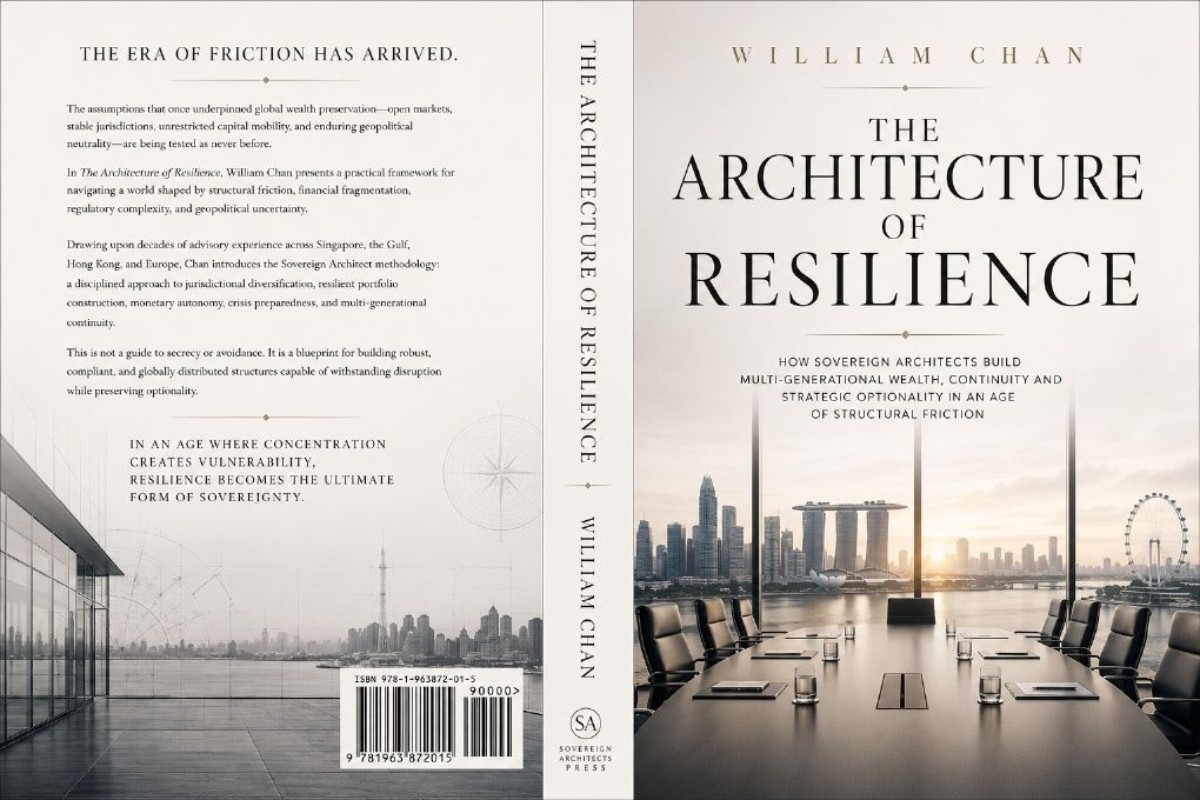
I have always been interested in the question of how wealthy families can preserve not only their assets, but also their freedom to act. William Chan’s new book, «The Architecture of Resilience», addresses precisely that challenge – and, in my view, at a particularly relevant moment.
Published in June 2026, the book carries the rather telling subtitle «How Sovereign Architects Build Multi-Generational Wealth, Continuity and Strategic Optionality in an Age of Structural Friction». William Chan argues that some of the assumptions wealthy families once took for granted – open markets, relatively stable jurisdictions and easy capital mobility – can no longer simply be assumed.
Wealth Preservation Is Becoming More Complex
What I find interesting is that Chan does not approach the subject simply as an investment problem. Drawing on advisory experience across Singapore, Hong Kong, the Gulf and Europe, he develops what he calls the Sovereign Architect methodology. It combines jurisdictional diversification, resilient portfolio construction, monetary autonomy, crisis preparedness and multi-generational continuity.
That resonates with what I increasingly observe in wealth management. For internationally mobile families, the crucial questions today extend far beyond portfolio performance. Where should assets be held? How concentrated should a family be in one jurisdiction, currency or banking system? How can structures remain robust if regulation, taxation or geopolitics change unexpectedly?
Resilience as a Form of Wealth
Chan, a former senior vice president at UBS who later founded Stamford Management Singapore, explicitly presents the book not as a manual for secrecy or regulatory circumvention, but as a framework for creating compliant, globally diversified structures designed to preserve strategic options during periods of disruption.
I think that distinction matters. Wealth management is gradually moving from a world dominated by optimisation to one increasingly concerned with resilience. And that may be the most interesting idea behind Chan’s book: for wealthy families, true wealth is not merely what they own. It is also the ability to retain choices when the world around them changes.
William Chan, The Architecture of Resilience, view the book on Amazon