Within the next few months, mounting geopolitical pressure is likely to push the world towards decisive tipping points, financial expert and political strategist Beat Wittmann predicts in his latest WealthSummit opinion piece. Autocrats, unconstrained by effective institutional checks and balances, will continue testing the limits of what they can get away with – until escalation triggers irreversible change.
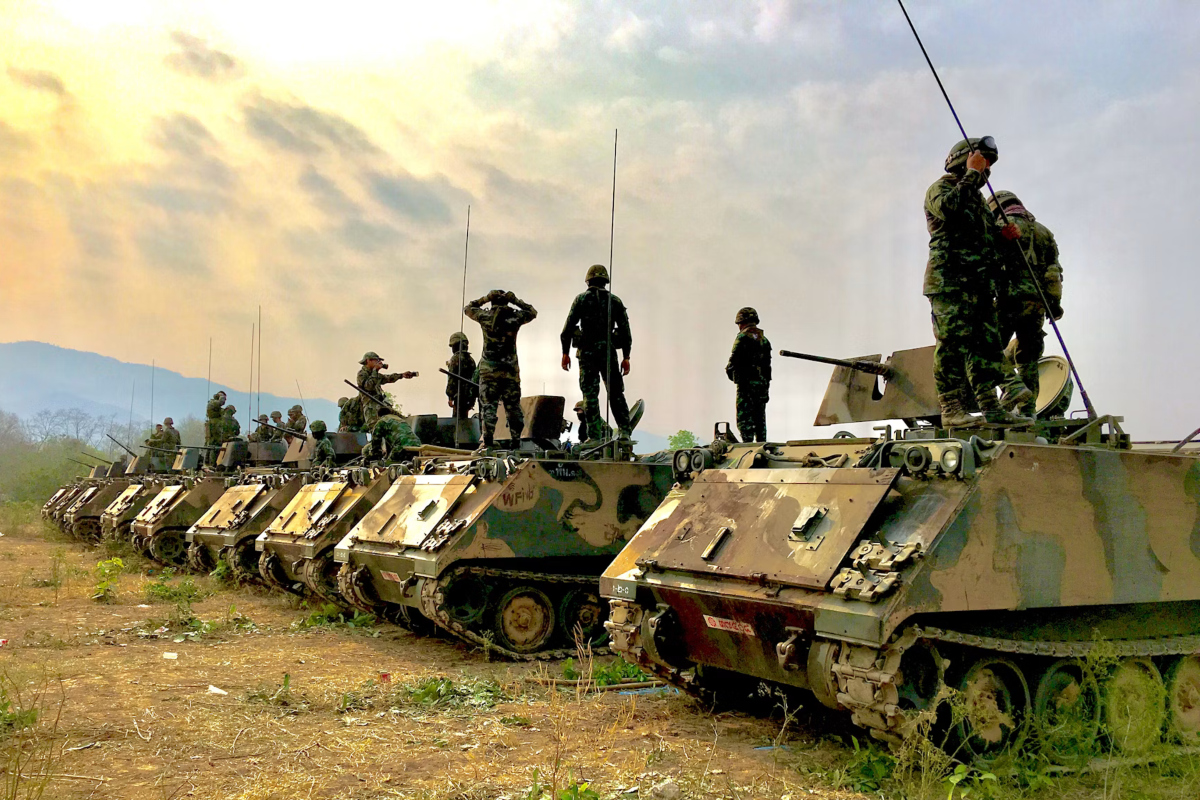
Army in Thailand (Image: Chuanchai Punde, Unsplash)
Escalation and tipping points describe how pressures rise within a political, economic, corporate, or financial system until a critical threshold is crossed and weak links break, triggering a sudden, massive, and often irreversible change.
Or, as Ernest Hemingway put it in his 1926 novel «The Sun Also Rises», where a character explains how financial ruin happens: «Gradually, then suddenly.» For real-life examples of sovereign and corporate crises and collapses, think of the UK (1979), East Germany (1990), the Soviet Union (1991), LTCM (1998), Russia (1998), Argentina (2001), Lehman Brothers (2008), Greece (2009), and Credit Suisse (2023).
Donald Trump’s Actions Now Being Discounted
Looking back, geoeconomics and financial markets have been characterized by manifold pressures building up and fault lines widening globally. Just think of the past weeks, with the powerful US president filling almost any media space and remaining center stage through unprecedented personal interference at the FIFA Football World Championship, mercurial behavior at the NATO summit in Ankara, the re-escalation of the war against Iran, and multiple arbitrary tariff actions against partners and foes alike.
Against this backdrop of news and noise, and the new normal of geopolitics, global economies and markets have remained remarkably resilient since May, moving largely sideways. In this context, always remember that financial markets can digest excessive price advances and valuations through sharp corrections, but also through sideways consolidation and sector rotation.
Importantly, the US president’s behavior is losing its surprise effect and impact. His actions are now being discounted and anticipated by international political counterparts, economic actors, and financial markets alike. All are highly incentivized to focus on their own affairs and businesses while diversifying away from, and de-risking in their respective ways from, the unilateralist US.
The Forces Set to Define 2026 and 2027
Looking ahead to the second half of 2026 and 2027, a few topics are set to dominate events and trends. These include Donald Trump facing the US midterm elections and doing whatever it takes to win; Russia escalating its losing war against Ukraine while Europe strives for sovereignty in defence, technology, and capital; the US-Israel war against Iran and the resulting reshaping of the balance of power in the Middle East; and, importantly, the all-consuming global race between the US and China for AI capabilities, capacities, and dominance, together with the directly related phase of creative destruction across the global corporate landscape.
In sum, we definitely do not expect «there was a lot of love in the room, a lot of unity,» as Trump said at the closure of the NATO summit, but rather geopolitical disruption and escalation towards various tipping points.
Trump’s Midterm Imperative: Win at Any Cost
A topic of central importance for the coming months, both for geoeconomics and financial markets, will be the upcoming US midterm elections. They will be crucially important for Trump to win, or at least to minimize electoral damage. Expect Trump, therefore, to do whatever it takes by deploying easing fiscal and regulatory policies to boost the US economy and markets and to dominate the global public sphere even more than he already does.
This will include further polarizing and poisoning the domestic political discourse and partisan conflicts, while Trump finds himself on the losing end of his miscalculated foreign and economic policy initiatives and plans, ranging from Russia and China to Iran and Cuba.
Let me emphasize, however, that we expect the US economy and capital markets to continue to perform in a resilient manner. On the one hand, the surprise value of Trump’s approach and actions has steadily declined; on the other, the size and depth of the US economy and markets remain very large and are internationally only marginally exposed.
Why Russia Is Likely to Choose Escalation
Russia has come under serious pressure and experienced a steady reversal in fortunes in its war against Ukraine. This is because Ukraine has brought the war deep into Russian territory, Vladimir Putin is facing mounting domestic discontent and economic pressures, and Western financial and military support for Ukraine is becoming stronger.
There are basically three scenarios for the remainder of 2026 and 2027: continued exhaustion and a war of attrition on both sides; Russia accepting some form of a Diktatfrieden; or Russia escalating through general mobilization to achieve escalation dominance.
History and system dynamics lead us to assign the highest probability to Russia choosing the path of military escalation. Moscow’s calculation appears to be that accepting a Diktatfrieden could mark the end of Putin’s rule; Russia enjoys Chinese support and a US appeasement stance; Ukrainian elites remain engaged in factional infighting while Ukrainian society is exhausted and ripe for compromise; and European support for imposing sanctions and providing military assistance remains fragmented and still too often driven by vested national and corporate interests.
In war history, developments most often have to get worse before they get better, and this war has already lasted far too long. It was predictable, and indeed predicted, that three elements would ultimately end Russia’s war of choice against Ukraine and the European security architecture: comprehensively sanctioning Russia to isolate and exhaust it economically; conducting deep precision strikes into Russia to destroy military assets and incapacitate critical infrastructure and logistics supporting the Russian war machine; and maximally supporting Ukraine and Russia’s European neighbors to enable them to secure national sovereignty and economic prosperity.
Europe’s Reckoning: From Peace Dividend to Strategic Power
Ultimately, it is up to Europe, and not the US, to move from complacency and consuming a peace dividend towards advancing strategic autonomy and investing in its defence by mobilizing public and private capital. Since Russia’s war against Ukraine, significant progress has been made, but much remains to be done to overcome fragmentation and national vested interests across the defence and financial sectors.
Sadly, exogenous shocks are typically required to mobilize awareness of national security and investment in military deterrence and readiness. As too many European leaders still only pay lip service to epochal changes due to Russia’s military attack, the most logical consequence would be to immediately reintroduce mandatory military service and live up to national constitutional obligations to finance the rehabilitation of the armed forces.
The unacceptable reality so far remains that, for NATO defense-expenditure-compliant Germany, Poland, Scandinavia, and the Baltics, there are too many free-riding nations and corporate interests either looking the other way or, as recently in the case of Greece, vetoing the EU’s sanctions package to protect a Greek shipping billionaire’s business interests with Russia.
Iran War Settles Into a Dangerous New Normal
We maintain our view that the US-Israel war against Iran has been a massive strategic miscalculation and failure, characterized by a lack of thorough analysis, clear objectives, a consistent strategy, and effective execution. It will not be won by either side at any point, but instead will lead to a new normal of sorts – a state of disequilibrium in the Middle East.
The direct economic and market consequences will be contained over time, apart from some cost-push inflation and temporary stagflation risk. At the same time, relevant regional stakeholders will diversify by investing in additional transportation infrastructure to mitigate the crucial Strait of Hormuz chokepoint.
With US voters consumed by the cost-of-living crisis, expect Trump to walk away during the coming weeks while proclaiming victory. This would enable energy and natural-resource trade to resume, albeit with a volatile and permanent risk premium attached.
Markets at a Crossroads: Why Equities Still Lead
Global capital markets, and particularly US markets, are caught between short-term overheating – manifested in low equity-market volatility, tight corporate-credit spreads, overconfident investor sentiment, low portfolio cash levels, and high margin loans – and, on the other side, solid corporate earnings, resilient macroeconomic conditions, and an underlying structural investment and productivity trajectory driven by new technologies and the AI revolution.
Consequently, equities remain the asset class of choice. Given the regionally fractured global economy, it is highly recommended to concentrate investments in one’s own geographic region and reference currency.
The structurally preferred sector themes remain defence, technology, and critical infrastructure. Particularly in the highly complex and traditionally low-transparency defence-industrial-tech sector, we recommend investing through diversified and professionally managed private-market collective investment vehicles and public equity indices.