From his vantage point in Singapore, Parag Khanna watches the world shift. Speaking to Switzerland’s prestigious weekly magazine «Die Weltwoche», the influential political scientist describes an Asia that builds while the West debates – and a globalization that continues, regardless of what politicians proclaim.
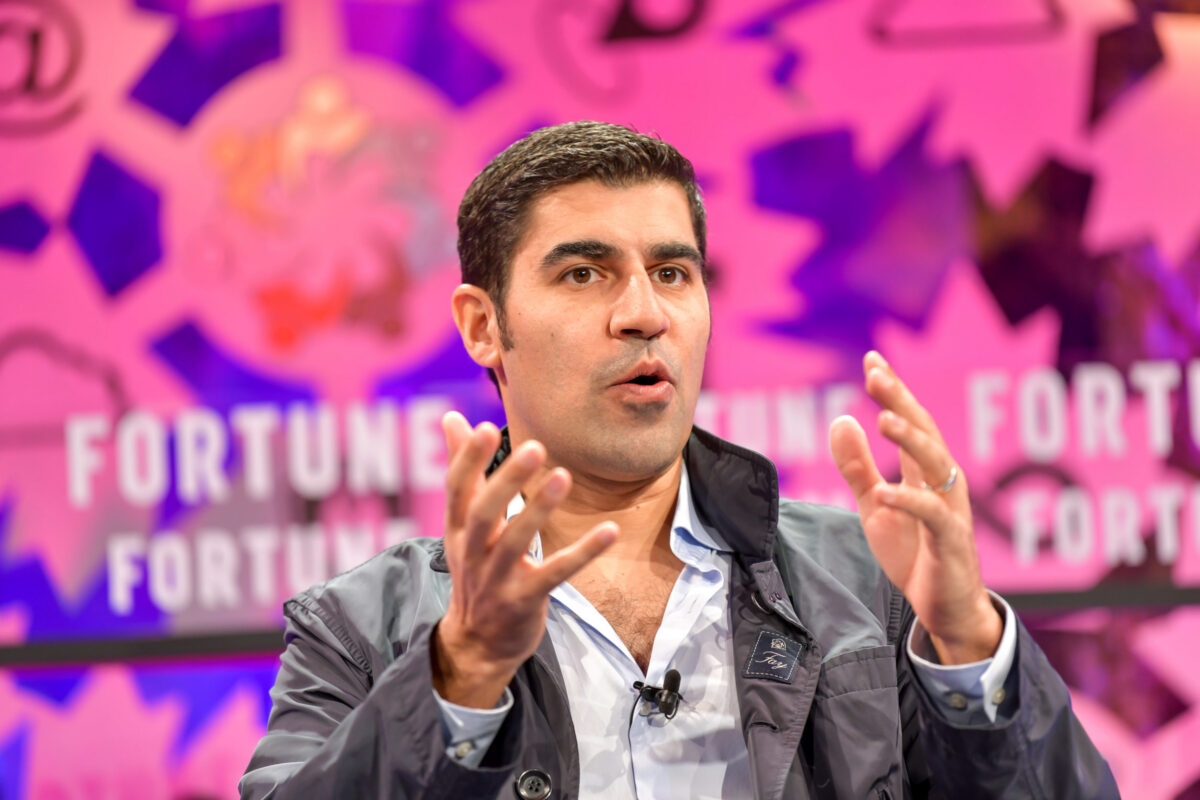
Speaking at Fortune Global Forum (Image: Courtesy of Parag Khanna)
- This interview was first published in «Die Weltwoche» in April 2026.
The Indian-American dual citizen Parag Khanna, born in 1977, is considered one of the most influential political scientists of our time. Over the past twenty years, he has published around a dozen books in which he anticipated numerous megatrends, including the economic rise of Asia, global digital interconnectedness, and the growing importance of migration and demography.
Khanna’s central thesis is that the world is increasingly dominated not by nation-states, but by networks, infrastructure, and economic interdependence. He studied at Georgetown University in Washington, D.C., and earned his doctorate in international relations at the London School of Economics.
Today, based in Singapore, he works in multiple capacities: advising governments and corporations, working for various think tanks, and simultaneously serving as founder and CEO of Alphageo, a geopolitical risk consultancy.
His success has also earned him many critics, who accuse him of intellectual superficiality, oversimplification, and political bias. Yet the criticism rarely rises above cheap polemics. It likely stems above all from the fact that Khanna takes clear positions expressing his preference for efficiency, geopolitical pragmatism, and realpolitik.
Parag Khanna, are we currently experiencing a new quality of global conflict?
Not really. We have lived far too long with unresolved or so-called «frozen» conflicts, and many people have become complacent about them. I never was. If a conflict is not truly resolved, it does not remain frozen forever. Eventually, it explodes.
And that is now happening?
That applies whether one is talking about the Gulf region, Ukraine, the South China Sea, Taiwan, or other places to which the West pays little attention. Just because citizens in Switzerland, Germany, or the U.S. are not focused on Nagorno-Karabakh does not mean that the people there are satisfied with the status quo. They live with the consequences every day.
My education and research made me skeptical of the idea that tensions can simply be managed indefinitely without consequences. I spend a great deal of time traveling, observing, and speaking with people in the regions themselves. When you do that, you stop being surprised by new conflicts. One may, of course, be alarmed, but «surprise» is the wrong word. In many cases, the warning signs were there all along.
Yet the current situation does seem highly unusual and unpredictable. In Washington, political directions seem to change almost daily. Is this a new reality we must now live with?
I would be careful about calling it new. Instability, unpredictability, polarization, and political reversals in Western politics did not begin yesterday. We have seen this pattern for years.
For example?
Take the Obama administration. It announced a «pivot to Asia,» but was unable to pass the trade architecture that would have anchored that shift. We have seen repeated back-and-forths in relations with North American neighbors, in European policy, in handling the eurozone, before and after Brexit.
The idea that U.S. policy has suddenly become unreliable overlooks the deeper continuity: unreliability is a structural feature. By contrast, many Asian states – despite their imperfections, despite illiberal tendencies, despite the externalities they may generate – have been more consistent in pursuing long-term improvements in material prosperity.
That is what matters: that people can measure effective progress in living standards, infrastructure, education, and public services.
And consider this as well: most people in Asia live in democracies. India is a democracy. Indonesia is a democracy. Japan is a democracy. The Philippines is a democracy. If you add these populations together, more people live under democratic systems in Asia than in any other region of the world.
The old Western habit of speaking as though democracy were somehow uniquely Western or morally monopolized by the West is simply false.
Many Europeans would hesitate to describe Asia as a democratic success story.
On paper and in demographic reality, it is a fact that a large part of humanity lives in Asian democracies. Naturally, these systems differ in quality, just as Western democracies differ in quality.
But I would add another point: many Asian societies focus more strongly on what governments are actually supposed to deliver.
What do you mean by that?
Western politics today is often consumed by identity debates, symbolic confrontations, and highly mediated culture wars. Many Asian states, by contrast, focus far more on practical governance: jobs, schools, transportation, housing, public safety, infrastructure, and growth.
That does not mean they are apolitical; it means their politics are more results-oriented.
One of the West’s greatest mistakes after the Cold War was believing it had reached «the end of history» – that the liberal-democratic capitalism practiced in the Atlantic world represented the final form of political development. That encouraged a kind of moral and intellectual complacency.
Meanwhile, much of Asia simply kept working.
I say this analytically, not rhetorically: many Asian societies today are better organized in daily life than many Western societies. Their citizens often have a clearer understanding of what the state should provide, and they hold political leaders accountable on that basis.
That does not mean they are copies of one another, nor does it mean they want to imitate the West. In fact, for twenty years, I have argued the opposite: no society wants to become another society. Every society wants to become a better version of itself.
So the central question is not whether one model defeats another, but which societies improve themselves in absolute terms?
Exactly. The only question is whether a society tomorrow is a better version of itself than it is today. That is the race that matters.
And if you allocate capital, that should matter to you as well. Which societies are rising? Which are stagnating? Which are declining? That is precisely where geopolitical analysis and investment analysis intersect.
It is not about cultural imitation. Singapore is not trying to become Sweden. India is not trying to become France. The UAE is not trying to become Britain.
Each of these societies is trying, in its own way, to improve its own capabilities and resilience. The investor’s task is to recognize where that process is real.
Where does that leave the U.S.? Is America a rising or declining country?
It is both more resilient and, at the same time, more impaired than many people think.
The U.S. remains a massive economic space with deep strengths. It continues to generate growth. It continues to attract talent. It still possesses extraordinary innovative capacity, particularly in artificial intelligence, advanced technology, and capital markets.
However, one must look closely at the composition of that growth. If it is driven by debt-financed consumption, speculation, fiscal tricks, and increasingly concentrated profits, then one has to ask whether nominal growth is truly translating into broad prosperity.
Absolutely. You can generate short-term growth by expanding credit and removing constraints, but that is not the same thing as building a sound and equitable political economy.
What is your conclusion?
I am relatively optimistic about the U.S. as an economic space. I am far less optimistic about the U.S. as a political system characterized by moral seriousness, institutional balance, and public purpose. Those are different questions.
Is that mainly due to Donald Trump? Has the U.S. drifted into a phase of crony capitalism?
No. The U.S. was systemically corrupt before Trump. We need to be clear about that.
Financial deregulation, the repeal of the Glass-Steagall Act, the Citizens United decision, the growing ability of wealthy interest groups and corporations to influence political outcomes – these developments entrenched a deep structure of legalized corruption over decades.
What Trump represents is not the creation of corruption out of nothing. He represents its acute intensification.
We now have a White House openly engaging in forms of self-interested behavior, normalizing and expanding practices that were already embedded in the system. That is an additional factor, and a dangerous one, but it did not emerge in a vacuum.
Against this background, do you see any strategic coherence in what Trump is doing – beyond self-interest?
One can always construct an abstract argument that speed and decisiveness sometimes produce results, even if the process is unpleasant.
You sometimes hear: «Well, perhaps a bridge is built through questionable means, but in the end, the bridge at least serves the public.» That line of reasoning exists today.
But it does not really explain Trump. Much of what we are discussing is not a ruthless developmental state bypassing bureaucracy in the public interest. It is far more self-referential than that.
Whether it involves personal branding, private gain, opportunistic policy shifts, or other projects, the center of gravity is no longer the public good.
Those are bleak assessments for the world’s largest economy.
Nonetheless, I do see a positive development: companies and investors are being pushed by communities and markets to behave more responsibly in areas where the state is absent or acts erratically.
Large corporations now understand that if they invest somewhere, they may also have to contribute to water systems, electricity access, or local public goods in order to maintain legitimacy.
That pressure does not come from the White House. It comes from society. And in some cases, that leads to better outcomes than politics produces.
For many Europeans, Trump nevertheless represents a threat and a symbol of political dysfunction. How do you assess that view?
I think the European perception is broadly correct. The corruption, the volatility, the ideological extremism – all of that is visible.
The question is not whether Europe understands this and whether it is right. The question is how Europe responds.
What is your answer?
Ideally, one would prefer American political pathologies to remain contained within America. But that is not how a superpower works.
The U.S. does not simply keep its internal struggles to itself. It exports them – through security policy, digital platforms, media narratives, ideological influence, even through open support for disruptive political forces within Europe itself.
Europe should therefore think strategically. It could confront digital platforms by enforcing content regulation. It could retaliate economically if tariffs are imposed. It could redirect capital inward. It could make itself more attractive to talent.
In short, Europe could actually benefit from American dysfunction.
Can Europe realistically pursue such a strategy?
If U.S. politics become so toxic that talented Americans would rather live in Europe and postpone decisions, that benefits Europe. I already see signs of that.
In some respects, Europe can simultaneously shield itself from the disadvantages while capturing some of the advantages generated by American instability.
Will the U.S. midterm elections slow the current direction under Trump?
Only to a limited extent. Even if the White House loses control of Congress, that does not necessarily change the deeper character of executive action.
We have already entered an era in which executive power has been dramatically expanded under presidents of both parties.
What are the likely consequences?
If the government is divided, there may be more gridlock and veto points. That slows things down. But it can also drive presidents to govern even more through executive orders, administrative maneuvers, and informal instruments of power.
Therefore, I do not believe a midterm election result by itself will restore balance. The deeper problem is structural.
Namely?
If a Democrat wins in 2028 and then needs a thousand executive orders to reverse the previous thousand executive orders, what exactly have we restored? At that point, the system itself is signaling dysfunction.
In your earlier books, you long advocated a collective executive government modeled on Switzerland and federal structures. Do you still believe in that today?
Absolutely. The more politics revolves around a single savior figure – whether from the left or the right – the more I believe the system has already failed. Healthy politics should not depend on the temperament of a single person.
That is why I have always admired the Swiss model: the Federal Council as a balanced executive, collegial leadership, power-sharing, institutionalized rather than improvised compromise.
All of that reduces the risk of presidential absolutism and forces pluralistic interests into the governing process.
In a large and polarized society like the U.S., a collective executive would not solve every problem. But it would address one of the most destructive features of the current system: the concentration of political emotion and practical power in a single office.
In other words, could the Swiss system serve as a model for the U.S.?
Yes, absolutely. I already wrote that in my 2017 book «Beyond Democracy.»
You are currently working on a book arguing that globalization is still advancing. Why do you believe that?
Because globalization is far more resilient than people think.
Many commentators confuse a change in the institutions or narratives of globalization with the end of globalization itself. Analytically, that is wrong.
Why?
Globalization is not identical with a particular phase of a Western-led liberal international order.
It cannot be reduced to the IMF, the World Bank, the WTO, or the language of the rules-based order after the Cold War. Those were historically specific arrangements that supported a particular phase of global integration.
But globalization goes much deeper.
Namely?
At the most fundamental level, globalization is about the continuing linkage of supply and demand across space.
Your raw materials are in one place, your production in another, your markets in a third. The logistical, financial, and technological connections between them constitute globalization.
It is first and foremost an empirical condition before it is a normative project. In that sense, globalization is extraordinarily difficult to reverse. Crisis after crisis has revealed not our isolationism, but our interdependence.
Even when states talk about strategic autonomy, redundancy, resilience, or friend-shoring, they are not leaving the global system. They are reconfiguring their place within the existing system.
How do you assess globalization under current conditions?
People need to remember what globalization actually is. They must stop confusing a Western interpretation of globalization with globalization itself.
The world may be moving from one form of integration to another, but that is not deglobalization in the absolute sense. It is a transformation.
In historical terms, when did globalization begin?
In the broadest human sense, when the first humans left Africa.
Mobility, exchange, diffusion, adaptation – these are ancient processes.
Of course, the speed, scale, and technological sophistication of globalization have changed dramatically. But the impulse toward connectivity is very old.
Years ago, you wrote that Asia had become the center of the world economy. How do you see that today?
Asia never waited for Western applause. It did not need someone in London, Washington, or Berlin to announce that the message from Asia had been received.
I would add a psychological point here: much of Asia simply no longer organizes its self-understanding around Western opinion.
East of Istanbul lives the majority of humanity. Most people wake up and focus on improving their own society, their own livelihood, and their own systems. They do not anxiously wait for commentary from the «Atlantic world.»
If Western societies had the same practical focus, they might be far better at solving their own problems. Asia’s strength lies not in any abstract civilizational triumphalism, but in a disciplined orientation toward development.
Europe can simultaneously shield itself from the disadvantages and capture some of the advantages.
And what about the much-praised small states? Countries like Switzerland, Singapore, and the UAE were long considered showcase examples or privileged exceptions. Are they now entering a more vulnerable phase?
In some ways, successful small states are always vulnerable, but they are also what I call «antifragile.»
Every decade brings some regional or global crisis, and yet these systems often emerge stronger because they become magnets for capital, talent, and security. Switzerland, Singapore, and the UAE each benefit from this dynamic.
In times of macroeconomic instability, safe havens become more attractive at the micro level. Capital flows in. Skilled people relocate. Currencies and financial systems strengthen.
Precisely the characteristics that made them successful in calmer times become even more valuable in times of disorder. That does not mean they are invulnerable. Of course not. It means that their size, flexibility, and strategic clarity often allow them to turn turbulence into a relative advantage.
Dubai now seems quite challenged. Was its image merely based on social-media hype and influencer glamour?
No. I have written extensively for many years about the UAE, especially Dubai and Abu Dhabi, but not because I wanted to create a myth. I observed a real transformation.
Places once dismissed as peripheral backwaters became central nodes of the global system. That is a historical process that continues even now. Dubai matters not merely as an image or brand; it has material significance.
Watch what happens with private markets, infrastructure flows, or large allocation strategies when Gulf capital changes direction. These states are more central than many still assume. That will not change.
How does that connect to your startup activities at Alphageo?
Very directly. The worse the climate crisis becomes, the more investors, sovereign wealth funds, pension funds, and infrastructure managers must think about physical risk and resilience.
They own railways, pipelines, refineries, data centers, logistics corridors, ports, real estate, and energy facilities. They need to know where they are exposed and how they can adapt. That is why adaptation is becoming such an important field.
Our software helps institutional clients assess climate risks and plan resilience investments around their physical assets. Increasingly, we also integrate geopolitical overlays.
That way, clients can understand not only climate exposure, but also whether assets are located near geopolitical contingencies or destabilizing zones.
What conclusion do you draw from that?
The future of risk management is neither climate nor geopolitics alone. It is the fusion of both. The world is entering a phase in which resilience – not just efficiency – will determine long-term strategy.
- This interview was first published in «Die Weltwoche» in April 2026.